Wednesday, 18 July 2018

TUM Wildspitze (3768 m) Expedition

Munich is an Alpine city. With the Alps close by and having the people who run the German mountain guide scheme in our faculty, I thought it was a good idea to run a course in Mountain Sports where we combine challenging life sciences topics related to mountain sports and altitude/hypoxia with practical training in mountain sports. The highlight of this course is the high altitude expedition to the Wildspitze. The students have to pre-acclimatise and train themselves based on the best available evidence and also run small experiments related to oxygen saturation, energy expenditure estimation and the P/O ratio during fat and carbohydrate combustion. 

Here, we have reached Vent in the Ötztal which is the base for our expedition. 
 We first ascended to the Breslauer hut at 2844 m.
Lower down it is not all nature...
 ... but soon we left noise and valley life behind. 
 Our guides were Gudrun Weikert, the first German female mountain guide and Andy Weikert, a guide that runs the German mountain bike scheme together with Gudrun. 
 We ascended up to a small peak at 3000 m...
 ... before descending to the Breslauer hut for food and more or less sleep.
 Here the food bit.
 We had breakfast at 5 am and then ascended...
 ... over some snow fields where we put on crampons...
 ... towards the glacier ...
 ... and the ascent also included a via ferrata.
 Here is Mika, an Erasmus student from Jyväsculä.
 After that we roped up on the glacier...
 ... to reach the base of the last ridge...
 ... which we then scrambled up ...
 ... to reach the summit. 
 During the descent it became foggy...
 ... but after a gentle descent on the upper glacier...
 ... we reached sunshine and the step to the lower glacier... 
 ... for a rest.
 More glacier descent on slush...
 ... holes in the glacier...
 ... and then some ice screw and ice climbing training on the lower glacier. 
 Here is Julius refining his technique...
 ... and here is Julia. 
 After all that a long walk to the Vernak-hut.
 The next morning the teams split. Andy led another glacier expedition and we got an introduction to rock climbing and via ferratas from Gudrun. 
Here is the more exposed via ferrata section with Mika leading the charge...
... and here the whole team is on the wire...
... to reach the second summit at roughly 3200 m. Maria is well pleased.
Here, is Gudrun at the top. 
 Here is Mika on the descent to the Vernakhütte...
 ... here a photo on the long walk back to Vent...
 ... over a free hanging bridge...
 ... until we could see the village of Vent. 
I was impressed with the fitness level of the students who prepared themselves well for the altitude. A great expedition and clearly an asset of studying Sport and Exercise Science at TUM. 
HW

Sunday, 8 July 2018

Munich Mountain biking

For outdoor & adventure sports, few large cities are a better base than Munich. For climbing, Arno and I have quickly discovered the Wilde Kaiser. But if the weather is not stable enough for the long routes we go mountain biking. And within 1-1.5 h, there are plenty of fantastic mountain biking venues on surfaces ranging from high-quality gravel roads to tricky trails.

The toughest tour this year so far was on the 9th of July and started in Bayrischzell. It was only 42 km long but but it covered 1718 altitude metres. Here is Arno at the start, ascending out of gorgeous Bayerischzell.  
 Great tracks but many steep bits...
 ... and sometimes not so steep bits...
 ... to meet some horses...
 ... before descending to the Brünnsteinhaus for an alcohol-free Weisses (honest!) and some soup. 
 We then decided to add more altimetres by adding a loop down to the bottom of the glen only to climb back up...
 ... to reach an Alm.
 ... followed by some meadows...
 ... and by a not quite so straightforward trail.
 Sun & heat at the bottom...
 ... which I enjoyed, too. 

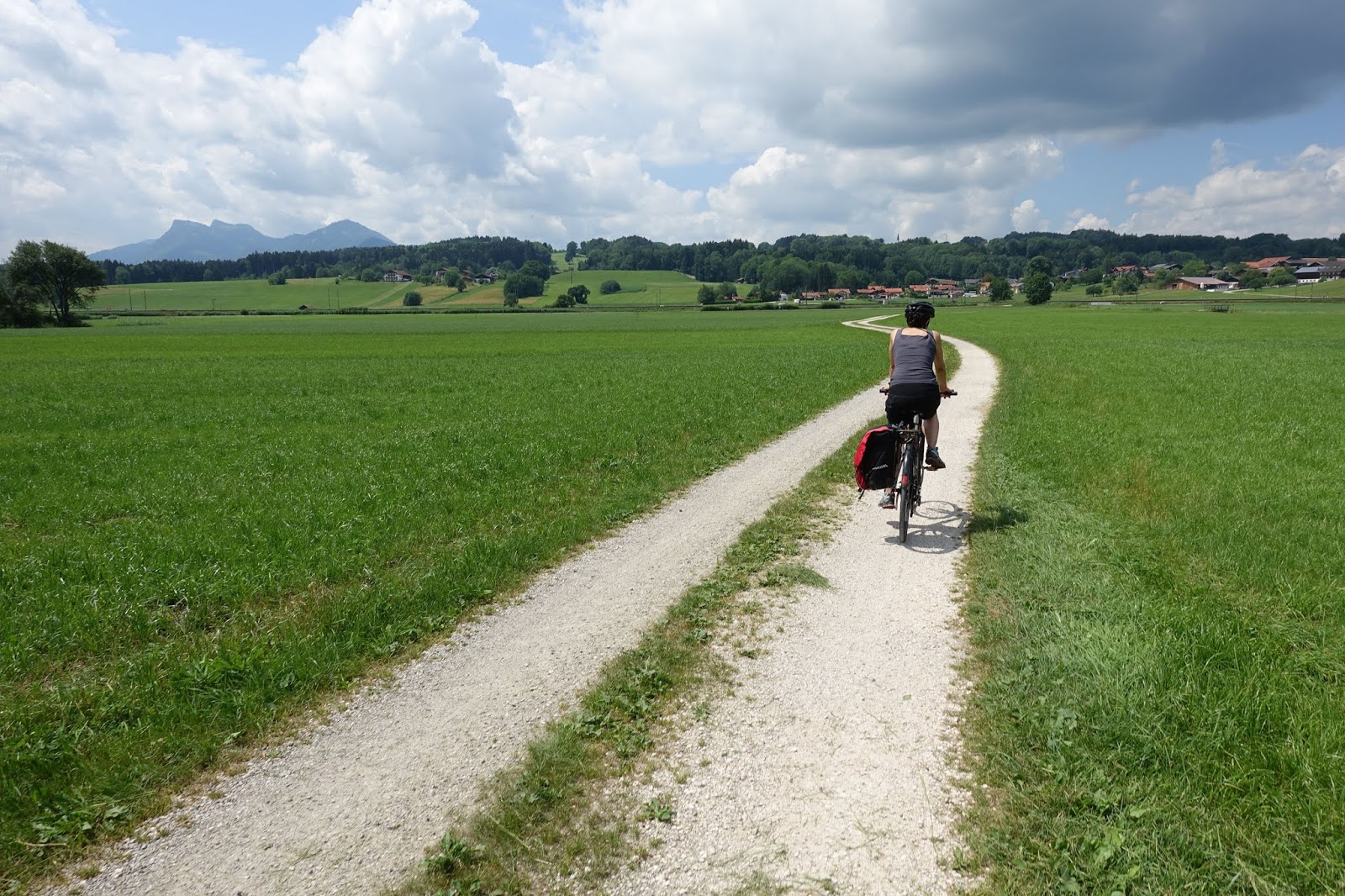
But it is not all about mountain biking here in Munich. Road cycling is fantastic too and recreational gravel cycling is very popular. One of the cycle classics is the round around the Chiemsee which Ana and I did on the 10th of June 2018. Here is Ana on a typical gravel path in gorgeous upper Bavaria. 
 This is gods own cycle country and thus there are many cyclists. 
 Here, lake Chiemsee. The whole round around the lake is 61.5 km. 
 Plenty of beaches to chill...
 ... and plenty of boats, stand up paddlers and kayaks.
A great day especially because we escaped the thunderstorms. 

Finally, I had my appointment with two proper bicycle guns, Thorsten and Nico on the 24th of June. We did the - let's get it done and over with - "Wank-Runde". Well, you think, I knew these Germans were dodgy but surely there must be a typo. There is no typo. Garmisch-Partenkirchen is "Wank" here, there and everywhere (there is even a poster saying "we want a Wank-tunnel for our children now!"). All that is fine as long as you have managed to avoid the more obscure vocabulary of the English language that is not typically taught of school. So what is the "Wank"? It is a mountain in Garmisch-Partenkirchen and I avoided it so I did not need to use the "W***" word. 

Luckily we have dealt with the W*** issue now so let us focus, esteemed reader, with the cycle ride itself. Here are Nico and Thorsten on the first bit, a long, tough, bad ramp with up to 24% ascent. 
 Then a coffee at an Alm and then a descent to arrive in the glen with a gorgeous view of the Karwendel range...
 ... and the Zugspitze, the highest mountain in German. 
 Here, is Thorsten on a perfect mountain bike track that brought us to Mittenwald, a great base for mountain biking, walking, mountaineering and climbing (the Wilde Kaiser is better for climbing though). 
 After that another ascent...
 ... and a descent and ridge back to Garmisch. 

For today, Arno and I had planned to climb on the Wilde Kaiser again. But the forecast was not reliable enough and so a big, bad nearly 20 pitch route was out of the question. So I introduced Arno to my quick fix local route which goes around the Wallberg and Schinder with 46 km and 938 m of ascent. The start is in Kreuth, just South of the Tegernsee. 
A steady climb to an Alm, and then a descent with a bit of a trail. We played it safe at times as there were sharp, slippery rocks. 
 After that the steepest ascent but only 300 m up...
... followed by some cycling on the road, lunch in one of the many Alpine huts and a return to the car. 

In a nutshell, the Bavarian Alps are a great venue for mountain biking and there are plenty of places to hire bikes, or if the training status of your lower extremities is lamentable, e-bikes!
HW

Tuesday, 19 June 2018

Via Classica V, Wilder Kaiser

After a winter in Munich with much snow and skiing, summer weather arrived in April and since then it was warm. Arno and I worked long hours, climbed Wednesdays at the fabulous climbing wall in Thalkirchen and cycled a bit here and there. Mid June our no-big-climb-yet panic got bad so when Ana said that she was busy we agreed at 7 am and climb the Via Classica on the Wilder Kaiser.

The wild Emperor (there is a tame one next to it) is just 1 h 20 min from Munich and offers huge limestone walls and climbing history. It is also an ideal destination for Scottish climbers because there are direct flights from Edinburgh to Munich and with a rental car it will take you under 2 h to the Griesneralm which is the base for a huge amount of big climbs at any grade. Here is the map link:
https://www.google.de/maps/place/Griesneralm/@47.5798776,12.3296641,15z/data=!4m7!3m6!1s0x0:0xc0a0d1ec0e69b6fa!5m1!1s2018-06-24!8m2!3d47.5798776!4d12.3296641

Via Classica is a 15 pitch route with 86 bolts and Alpine V which is about VS. However, take some nuts because the bolts are mostly in the VS bits. It was set up and first climbed in 2002 by Niedermuehlbichler and Brandsttaetter and is popular so consider staying at the Stripsenjoch hut (book early). It is on the Fleischbank but on the North-Western side and the fact that it is in the shade is welcome on hot summer days. 

Here is the topo from an earlier trip. When we climbed it there was a snow field at the bottom. Via classica follows a line to the left of a huge cleft to a grass band and then climbs inside a cleft to the second grass band. After that easier climbing and then scrambling to the top of the Fleischbank. Do not underestimate the duration of the scrambling and check out how to get down from the Fleischbank summit to the 4 abseils. It is a long day!
Here is Arno walking up from the Griesneralm. It takes a bit more than 1 h to the start of the route. 
On the snowfield next to the start were two "Haudegen" that had no problem climbing not unsteep  hardish neve in trainers. The Stripsenjoch hut is on the bealach. 
 Here Arno starts the route. Avoid the UK approach but move quickly and carefully. This is the Alps!
 After the first traverse pitches climb under a chockstone and then chimney out onto a ridge.
 Here, Arno climbs a steep bit. The cleft is a long way below. Note that there is some lose rock on the flatter bits. 
 Several long but relatively...
 ... straightfoward pitches follow.
 Then a steeper V-wall..
 ... to the first grass terrace. The photo is deceptive as things are steeper than they look on the photo.
 Within the above piece of rock is a cleft. Here, Arno traverses...
 ... to the right...
 ... to end up in the big cleft. 
 Time to take it in. 
 There was an Austrian couple ahead of us. Here are the V pitches. Not overly tricky but remember you have climbed 10 pitches at this stage and carry a rucksack. It makes sense to practice rucksack climbing in Scotland.
 Here is Arno  on belay. The cleft is huge and the exposure is stunning. The highlight of the climb.
You reach the second grass terrace, climb two easy pitches and then end up in the sunshine (hopefully). The Stripsenjoch hut is now well below.
 A longish ridge scramble to the top of the Fleischbank next. From here great views to the other walls. Here is the Predigtstuhl, preachers chair. Sport the climbers...
 Here, Arno and the Austrians reach the top of the Fleischbank (2186 m).
 You will be greeted by a few tame jackdaws that are after your food. 
 After that a down scramble, a walk back up to above the bealach and then 4 abseils down to safe ground. 
Everything is well prepared. No rusty bolts but shiny stainless steel.
 From there gravel surfing and a via ferrata back to the Griesneralm.
 This time was the first time that we had our Helles and Kasspatzen whilst there was some light left. We are slowly learning the Kaiser game. 
HW